
How Much Do Ball Boys and Girls Make at Tennis Tournaments?
Tennis Ball Person Earnings Calculator
Estimate your potential earnings and net profit based on the tournament tier, duration, and travel costs.
You watch the pros smash forehands worth millions of dollars in prize money. Then you look down at the sidelines and see a teenager sprinting to retrieve a ball. It’s easy to assume they are there for free, or maybe just for the cool experience. But how much money does a tennis ball boy actually make? The answer isn’t a single paycheck. It depends entirely on whether you are working at a local club, a professional tour stop, or one of the four Grand Slams.
The reality is that being a ball person is rarely a primary source of income. For most teenagers, it is a side gig, a summer job, or a stepping stone into the sports industry. However, at the highest levels, like Wimbledon or the US Open, the compensation package includes perks that can be worth more than the cash wage itself. Let's break down exactly what these roles pay across different tiers of tennis.
The Local Club and Junior Tournament Reality
If you start your journey at a local community center or a small junior tournament, don't expect a salary. In fact, you might not get paid at all. Many local leagues rely on volunteers. Parents often sign their kids up to keep them out of trouble during matches, or teens do it to build character and learn the rules of the game.
When payment is involved at this level, it is usually minimal. You might earn between $5 and $10 per hour if the tournament has a budget. Some organizations offer "gift cards" or free entry to future events as compensation. The main value here is networking with local coaches and players, not the money. If you are looking to make rent, this is not the place to be. It is strictly for experience.
ATP and WTA Tour: The Professional Circuit
Once you move up to the professional circuit-specifically the ATP (men) and WTA (women) tours-the structure changes. These tournaments operate like businesses, and ball persons are considered temporary staff. They are not employees in the traditional sense; they are hired for specific weeks during the tournament schedule.
At a typical ATP 250 or 500 event, ball boys and girls typically earn between $80 and $150 per day. This translates to roughly $10 to $15 per hour, depending on the location and the tournament's prestige. A standard shift lasts about 6 to 8 hours. So, for a two-week tournament, a dedicated ball person could take home between $1,200 and $2,500 in cash wages.
However, the cash is only part of the story. At these professional events, you usually receive:
- Meals: Free breakfast, lunch, and dinner from the tournament catering team. This saves you significant money on food during the event.
- Apparel: You are provided with the official uniform, which often includes branded polo shirts, shorts, and sometimes even shoes. These items have retail value.
- Court Access: After shifts, you often get access to practice courts, allowing you to train for free.
For a student athlete, the free gear and meals can offset living costs, making the effective hourly rate higher than the cash suggests.
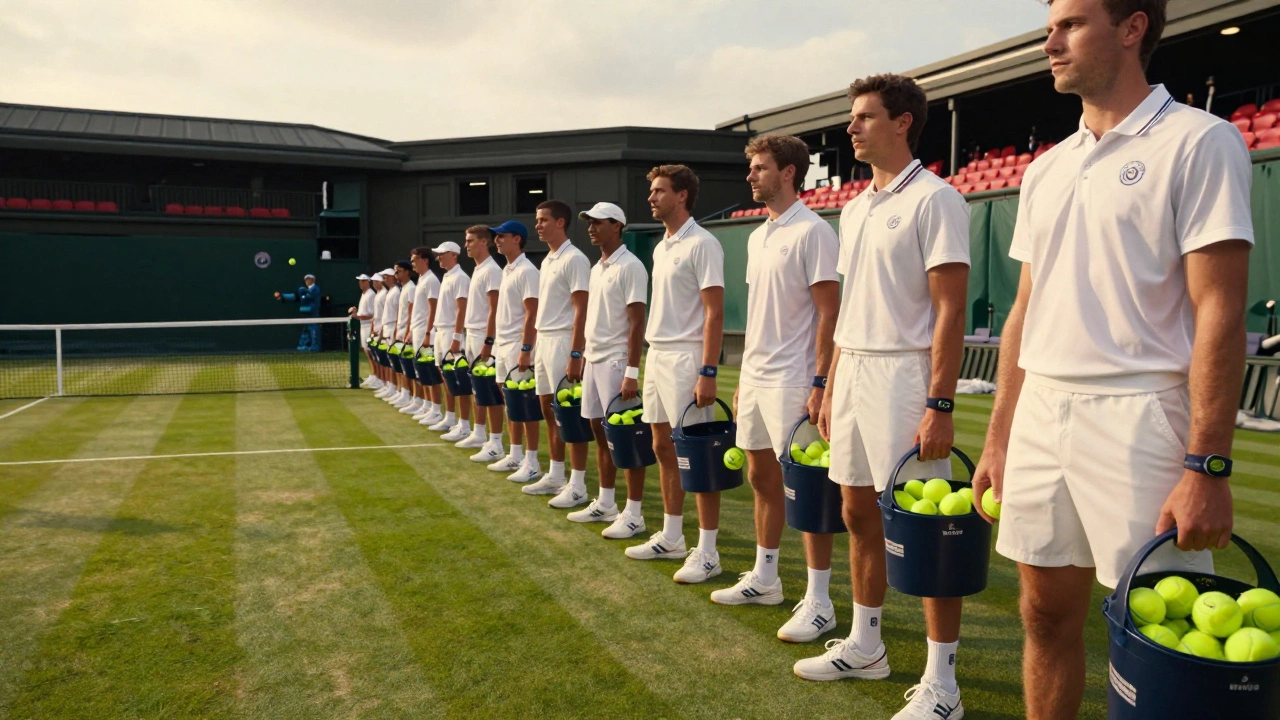
Grand Slams: The Big Leagues
The four Grand Slams-Australian Open, French Open, Wimbledon, and US Open-are the pinnacle of tennis. They also offer the most competitive packages for ball persons, though the cash varies by region due to local labor laws and cost of living.
| Tournament | Location | Estimated Cash Pay (Weekly) | Key Perks |
|---|---|---|---|
| Australian Open | Melbourne, Australia | $300 - $450 AUD | Free accommodation support, meals, merch |
| French Open | Paris, France | €200 - €300 EUR | Transport pass, meals, Roland Garros gear |
| Wimbledon | London, UK | £150 - £250 GBP | All-you-can-eat strawberries/cream, exclusive kit |
| US Open | New York, USA | $400 - $600 USD | Meals, transport stipend, high-end apparel |
Note that these figures are estimates based on recent reports from participants and vary slightly year to year. The US Open tends to pay the highest cash wages due to New York's high cost of living. Wimbledon, while paying less in raw currency, offers an unparalleled brand association that can help with future job prospects in sports management or media.
The Hidden Costs: Why It Might Not Be Profitable
Before you rush to apply, consider the expenses. Working at a Grand Slam or a major ATP/WTA event often requires you to travel. If you live outside the host city, you need to cover flights and hotels. While some tournaments offer housing subsidies or partner with hostels, the cost often falls on the individual.
For example, if you fly to Paris for the French Open and spend €800 on flights and accommodation, but only earn €250 in wages, you are technically losing money. Many ball persons accept this loss because they view the experience as an investment. Being on the resume of someone who worked at Wimbledon opens doors to internships in sports marketing, broadcasting, and event management.
Additionally, the physical toll is real. You are running on hard court or clay for six hours straight. Blisters, back pain, and exhaustion are common. You aren't just standing around; you are reacting to balls traveling at 120 mph. It is intense physical labor disguised as a spectator sport role.

How to Get Selected: It's Not Just About Money
Getting hired as a ball person at a top-tier tournament is highly competitive. Thousands apply for a few hundred spots. Selection committees look for:
- Tennis Knowledge: You must know the rules inside out. Line calls, tie-break procedures, and challenge system basics are fair game in interviews.
- Physical Fitness: You need speed and agility. Auditions often include sprints and ball-retrieval drills.
- Invisibility: The best ball person is the one no one notices. You must stay calm under pressure, avoid distracting players, and anticipate where the ball will land before it bounces.
- Language Skills: At international events, speaking English plus one other language (French, Spanish, Mandarin) is a huge advantage.
Most successful applicants are aged 16 to 25. Younger candidates are preferred for their energy and lower wage expectations, while older students bring maturity and reliability.
Is It Worth It?
If your goal is purely financial, there are better jobs. You could work at a coffee shop or deliver food for likely higher hourly rates with less stress. But if you want to break into the tennis industry, it is invaluable. You meet agents, broadcasters, and coaches. You see how a major event operates behind the scenes. You build a network that can lead to full-time careers in sports administration.
Think of the pay as a stipend rather than a salary. The real return on investment comes from the connections you make and the line on your resume that says you worked at the US Open. That credential carries weight far beyond the $500 you earned in August.
Do ball boys and girls get tips?
No, tipping ball persons is generally discouraged and often prohibited by tournament rules. Spectators are asked not to interact with ball crew during play to maintain focus and fairness. Any appreciation should be directed toward the umpires or players after the match, not through monetary tips to the ball crew.
What age do you have to be to be a ball boy?
Most professional tournaments require ball persons to be at least 16 years old. Some junior events may allow 14- or 15-year-olds, but Grand Slams and ATP/WTA tours strictly enforce a minimum age of 16 due to liability and physical demands. There is usually no upper age limit, but most participants are under 25.
Do you need to be good at tennis to be a ball person?
You do not need to be a skilled player, but you must understand the game. You need to know when a point is over, how to serve balls quickly to the server, and how to react to fast shots without getting hit. Physical fitness is more important than playing ability. Speed, reflexes, and stamina are key.
Are ball persons employed by the tennis players?
No, ball persons are employees or contractors of the tournament organizers, not the players. Players have no say in hiring, firing, or paying ball crew. The tournament management handles all logistics, training, and compensation for the ball crew.
Can you keep the tennis balls you collect?
Generally, no. Balls used during official matches are property of the tournament. However, some tournaments allow ball persons to purchase used balls at a discount after the event, or they may gift a few balls as souvenirs. Taking balls without permission can result in immediate dismissal.