
What Is the Best Full Body Workout? The Science-Backed Routine for Strength and Fat Loss
Full Body Workout Generator
Generate a science-backed full body workout plan based on your schedule and equipment availability.
Your Weekly Schedule
Key Principles for Success:
- Progressive Overload: Increase weight or reps slightly each week.
- Rest: Ensure 48 hours between sessions for the same muscle groups.
- Nutrition: Aim for 1.6-2.2g of protein per kg of body weight.
- Sleep: Get 7-9 hours to maximize recovery and growth hormone release.
You walk into the gym, look at the rows of machines, free weights, and cables, and feel a sudden wave of confusion. Should you split your week by body part? Do legs on Monday, chest on Tuesday? Or is there a better way? For most people chasing general fitness, fat loss, or functional strength, the answer isn't a complex bodybuilding split. The best full body workout is one that hits every major muscle group in a single session, three times a week.
This approach isn't just a trend; it’s rooted in how our muscles recover and grow. By training your whole body frequently, you stimulate protein synthesis more often than if you only trained each muscle once a week. You get more practice with movement patterns, which means better coordination and safer lifts. Plus, you burn more calories per hour because you’re engaging large muscle groups simultaneously.
Why Full Body Workouts Beat Split Routines for Most People
Let’s clear up a common myth: you don’t need to train six days a week to see results. In fact, for natural lifters and beginners, training a muscle group once a week might be too little stimulus. Research published in the Journal of Strength and Conditioning Research suggests that hitting a muscle two to three times a week leads to greater hypertrophy (muscle growth) compared to once a week, provided volume is equated.
When you do a full body workout, you prioritize compound movements. These are exercises like squats, deadlifts, presses, and rows. They recruit multiple joints and muscle groups at once. A squat works your quads, hamstrings, glutes, and core. A bench press hits your chest, shoulders, and triceps. This efficiency means you get a massive return on investment for your time. If you have a busy schedule, squeezing in three 45-minute sessions is far more sustainable than five hour-long ones.
There’s also the metabolic benefit. Because you’re using so many muscles, your heart rate stays elevated. You’re not just building strength; you’re conditioning your cardiovascular system. It’s a dual-purpose strategy that saves you from needing separate cardio days, unless you’re training for an endurance event.
The Blueprint: Designing Your Ideal Session
So, what does this "best" workout actually look like? It doesn’t require fancy equipment or a personal trainer. You need a structure that balances push, pull, and leg movements. Here is a simple, effective template you can follow:
- Warm-up (5-10 minutes): Dynamic stretching or light cardio to raise body temperature.
- Primary Lower Body Lift (3 sets of 6-8 reps): Squats, Deadlifts, or Lunges.
- Horizontal Push (3 sets of 8-10 reps): Bench Press or Push-ups.
- Vertical Pull (3 sets of 8-10 reps): Pull-ups or Lat Pulldowns.
- Horizontal Pull (3 sets of 10-12 reps): Bent-over Rows or Seated Cable Rows.
- Core/Stability (2 sets of 15-20 reps): Planks or Hanging Leg Raises.
Notice the order? We start with the most demanding movement-usually the lower body lift-when you have the most energy. Then we move to upper body pushing and pulling. We finish with isolation or stability work. This sequence ensures you’re fresh for the heavy lifts where injury risk is highest if form breaks down.
Sample A/B Split for Variety and Progression
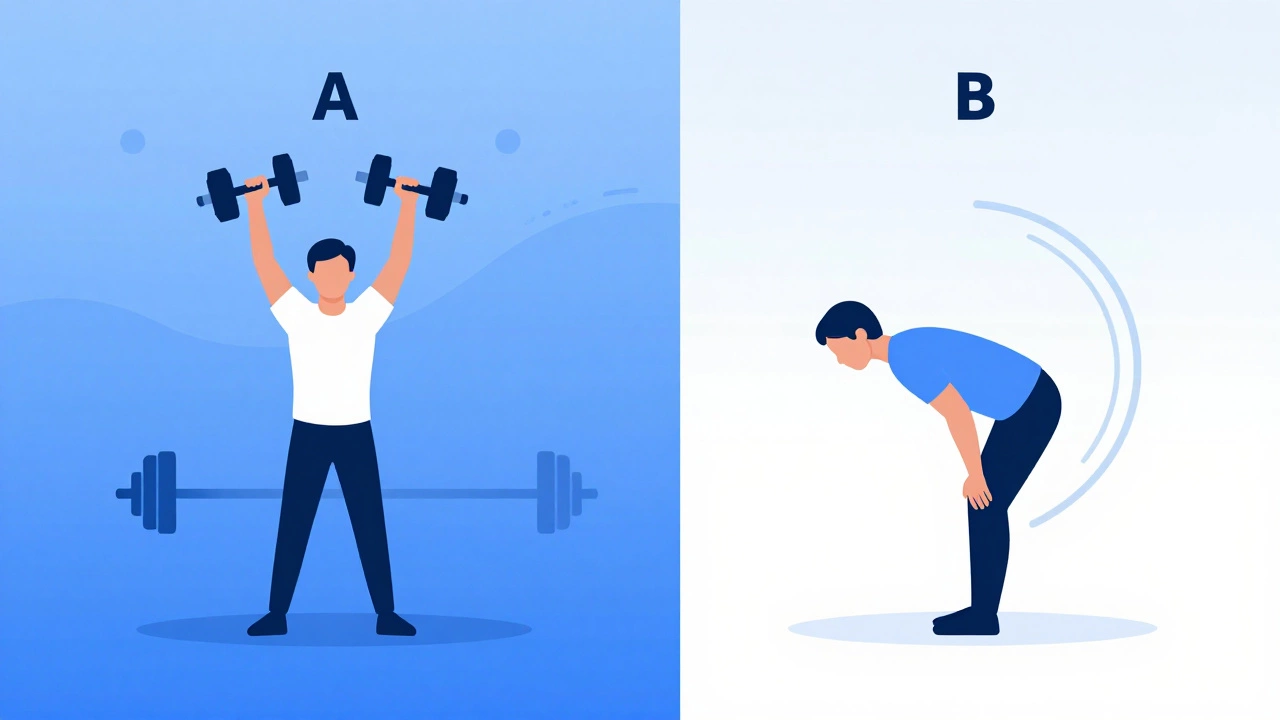
Doing the exact same workout every day can lead to boredom and plateaus. To keep progressing, try an A/B split. You alternate between Workout A and Workout B throughout the week. This gives you variety while still hitting every muscle group twice or thrice weekly.
| Movement Pattern | Workout A | Workout B |
|---|---|---|
| Knee-Dominant Legs | Barbell Back Squat | Goblet Squat or Front Squat |
| Hinge/Hip-Dominant | Romanian Deadlift | Kettlebell Swing or Hip Thrust |
| Vertical Push | Overhead Press | Dumbbell Shoulder Press |
| Horizontal Push | Bench Press | Incline Dumbbell Press |
| Vertical Pull | Pull-ups | Lat Pulldown |
| Horizontal Pull | Bent-over Barbell Row | Single-Arm Dumbbell Row |
By alternating these, you ensure no muscle group gets neglected. For example, if you focus on barbell back squats in Workout A, you might use goblet squats in Workout B to emphasize core stability and quad engagement without taxing your lower back as much. This variation helps prevent overuse injuries and keeps your mind engaged.
Progressive Overload: The Secret Sauce
A full body workout is only as good as your effort to improve. This concept is called progressive overload. It means you must gradually increase the demand on your musculoskeletal system. If you lift the same weight for the same reps for six months, your body will adapt and stop changing.
How do you apply this? Start small. If you can do 10 clean push-ups, aim for 11 next week. If you’re lifting weights, add 2.5kg (5lbs) to the bar when you hit the top of your rep range with good form. Keep a logbook or use an app. Tracking your workouts removes guesswork. You’ll know exactly what you did last time and what you need to beat today. This data-driven approach is what separates those who progress from those who spin their wheels.
Recovery: Where the Gains Happen
Training breaks your muscles down; rest builds them back up stronger. With a full body routine, recovery management is critical. Since you’re working your entire system each session, you shouldn’t train hard two days in a row. A typical schedule looks like Monday/Wednesday/Friday or Tuesday/Thursday/Saturday. This gives you 48 hours of rest between sessions.
Sleep is non-negotiable. Aim for 7-9 hours per night. During deep sleep, your body releases growth hormone, which repairs tissue. If you’re sleeping five hours, no amount of perfect form will save your progress. Nutrition plays a huge role too. Ensure you’re eating enough protein-roughly 1.6 to 2.2 grams per kilogram of body weight-to provide the building blocks for muscle repair. Hydration matters as well; even mild dehydration can reduce strength output by 10-15%.

Common Mistakes to Avoid
Even with the right plan, pitfalls exist. One major error is ego lifting. Trying to lift too much weight with poor form leads to injury. It’s better to master the movement pattern with lighter weights first. Film yourself or ask a knowledgeable friend to check your form. Consistency beats intensity in the long run.
Another mistake is neglecting mobility. Tight hips and shoulders limit your range of motion, making exercises harder and less effective. Spend five minutes after your workout stretching the muscles you used. Foam rolling can help release tension. Think of mobility as maintenance for your car; if you ignore it, something will eventually break down.
Finally, don’t underestimate the warm-up. Jumping straight into heavy squats is a recipe for disaster. Use dynamic movements like leg swings, arm circles, and bodyweight squats to prepare your joints and nervous system. A proper warm-up reduces injury risk and improves performance during the main set.
Adapting for Home vs. Gym
You don’t need a commercial gym to do a full body workout. If you’re at home, you can modify the exercises. Replace barbell squats with pistol squats or jump squats. Swap bench presses for push-ups or dumbbell floor presses. Use resistance bands for rows and pull-aparts. Kettlebells are excellent for swings and goblet squats. The principles remain the same: compound movements, progressive overload, and consistency. The location changes, but the logic doesn’t.
How many days a week should I do a full body workout?
For most people, three days a week is ideal. This allows for sufficient frequency to stimulate muscle growth while providing adequate recovery time between sessions. Beginners might start with two days, while advanced lifters could manage four, but three is the sweet spot for balance.
Can I build muscle with full body workouts?
Absolutely. Muscle growth depends on mechanical tension, metabolic stress, and muscle damage, all of which can be achieved with full body routines. In fact, higher frequency training often leads to better muscle protein synthesis rates compared to low-frequency splits.
Is a full body workout better than a split routine?
For general fitness, fat loss, and beginners, yes. Full body workouts offer more frequency, better calorie burn, and improved motor skill learning. Split routines might be beneficial for advanced bodybuilders focusing on specific lagging muscle groups, but they require more time and discipline.
What should I eat before a full body workout?
A meal rich in carbohydrates and moderate in protein about 1-2 hours before training is optimal. Carbs provide the fuel for high-intensity efforts, while protein aids in muscle preservation. Examples include oatmeal with fruit, rice with chicken, or a banana with peanut butter. Avoid heavy fats or fiber right before training as they can slow digestion.
How long should a full body workout take?
Aim for 45 to 60 minutes. This includes a 5-10 minute warm-up, 30-45 minutes of lifting, and 5-10 minutes of cool-down/stretching. Keeping sessions concise helps maintain intensity and prevents overtraining. If you find yourself taking longer, you may be resting too long between sets or adding unnecessary accessory work.