Do I Really Need Running Shoes? A Practical Guide
Running Shoe Advisor
Answer these questions to find out if you need specialized running shoes, or if a simpler option might work better for you.
Fill in your details and click "Get Recommendation" to see which footwear suits you best.
You’re standing in the shoe aisle, staring at a wall of neon foam and carbon plates. The salesperson is talking about "energy return" and "pronation control." Your wallet feels lighter just looking at the price tags. It’s a fair question: do you actually need specialized running shoes, or is this just clever marketing designed to separate runners from their cash?
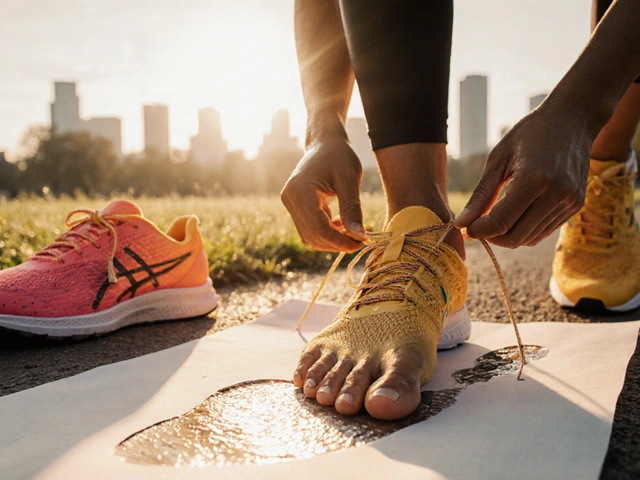
The short answer is no, you don’t strictly need them to run. Humans have been jogging for millennia without Nike or Adidas. But the longer, more useful answer depends entirely on where you run, how far you go, and what your feet are used to doing. If you’re sprinting across a sandy beach, you’re fine. If you’re pounding concrete for five miles in Dublin rain, going barefoot might leave you limping by week two.
What Do Running Shoes Actually Do?
To decide if you need them, you first need to know what they’re doing for you. They aren’t magic force fields that prevent all injuries. Instead, they act as a buffer between your foot and the ground.
Running Shoes are athletic footwear specifically engineered for forward motion. Unlike casual sneakers, which prioritize style or general comfort, running shoes focus on three main attributes:
- Cushioning: Absorbing impact forces when your foot strikes the ground.
- Stability: Guiding the foot to prevent excessive rolling (pronation).
- Protection: Shielding the sole from sharp objects, heat, and abrasion.
The midsole, usually made of EVA foam or newer materials like PEBA, compresses under load to reduce the shock transmitted up your legs. This isn't trivial. When you run, your body absorbs forces equivalent to 2-3 times your body weight with every step. Over thousands of steps, that adds up.
The Case Against Modern Running Shoes
Here’s the controversial part: some experts argue that over-cushioned shoes can actually weaken your feet. Think of it like wearing a cast. If your foot is fully supported and cushioned, the small muscles in your arch and toes don’t have to work hard. Over time, these muscles can atrophy.
Barefoot running proponents point to populations in places like Kenya or parts of India who run long distances with minimal footwear. They often land on their forefoot rather than their heel. Heel striking-common in people wearing thick-soled shoes-can send higher impact spikes up the tibia. Forefoot striking uses the calf and Achilles tendon as natural springs.
If you’ve grown up wearing supportive shoes since childhood, switching to barefoot running cold turkey is a recipe for disaster. Your tendons aren’t ready. But it does suggest that we rely too heavily on external support when our own bodies could handle more, provided we build strength gradually.
When You Definitely Should Wear Them
While barefoot running has its merits, there are scenarios where skipping shoes is a bad idea. Here is when you should reach for the laces:
- Urban Environments: Pavement is unforgiving. Glass shards, dog waste, and rough asphalt are real hazards. A thin layer of rubber protects against cuts and blisters that would stop you dead.
- Long Distances: For runs over 5km (3 miles), fatigue sets in. As your form breaks down, your landing becomes heavier. Cushioning helps maintain comfort and reduces cumulative stress on joints.
- Extreme Temperatures: Running on hot tarmac in July or freezing mud in January requires protection. Your skin isn’t insulated enough to handle extreme surface temperatures for extended periods.
- Pre-existing Conditions: If you have plantar fasciitis, diabetes, or neuropathy, your feet need extra care. Diabetics, in particular, risk unnoticed injuries due to reduced sensation. Protective footwear is non-negotiable here.
Types of Footwear: Not All Are Equal
If you decide you want something on your feet, you don’t necessarily need a $180 max-cushion monster. There’s a spectrum. Understanding where you fit helps you save money and avoid injury.
| Type | Cushion Level | Best For | Risk Factor |
|---|---|---|---|
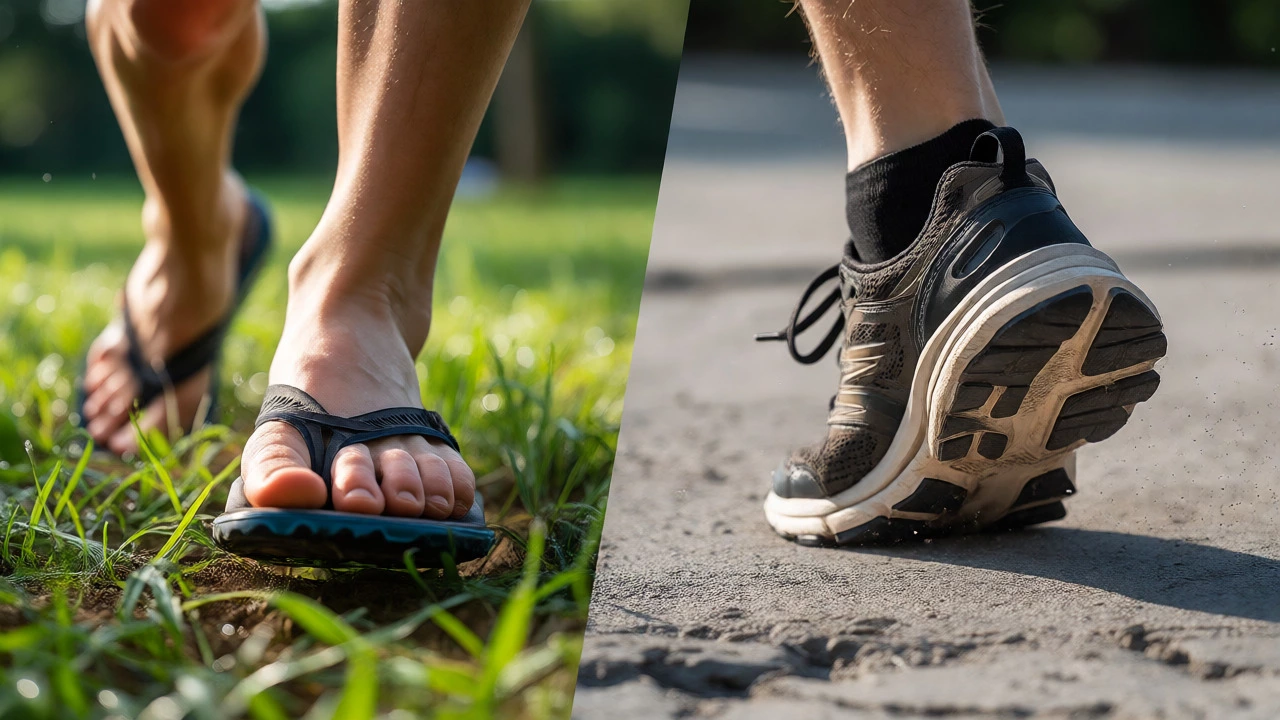
| Barefoot/Sandals | None/Minimal | Short runs, soft surfaces, strengthening exercises | High (cuts, bruising, tendon strain) |
| Minimalist Shoes | Low | Transitioning runners, gym workouts, light trails | Medium (requires gradual adaptation) |
| Traditional Trainers | Moderate | Daily training, road running, beginners | Low (standard safety net) |
| Max Cushion | High | Recovery runs, heavy runners, joint pain issues | Low (but may reduce proprioception) |
Minimalist shoes, like those from brands such as Vivobarefoot or Xero Shoes, offer a middle ground. They protect your soles but allow your toes to splay and your foot to flex naturally. They are great for building foot strength without the harshness of being completely bare.
How to Transition Safely
If you’re curious about ditching the clunky trainers, don’t throw away your current pair today. Your bones, ligaments, and tendons need time to adapt to new loads. This process is called remodeling.
- Start Slow: Walk barefoot around your house for 30 minutes a day. Notice how your balance changes.
- Grass First: Try short walks on grass or sand. Avoid concrete initially.
- Run Briefly: Once comfortable walking, try running for one minute barefoot or in minimalist shoes. Stop before you feel tired.
- Increase Gradually: Add 10% to your barefoot/minimalist volume each week. If you feel pain in your calves or shins, back off.
- Listen to Your Body: Soreness is normal; sharp pain is not. Sharp pain means you did too much, too soon.
Many runners find a hybrid approach works best. They wear supportive shoes for long weekend runs but train in minimalist gear during the week. This keeps their feet strong while protecting them during high-volume weeks.
The Cost-Benefit Analysis
Let’s talk money. A decent pair of running shoes costs between €80 and €160. They last roughly 400-800 kilometers. If you run 20km a week, you’ll replace them every 6 months. That’s a recurring cost.
Barefoot running is free. Minimalist sandals might cost €50 and last years if you take care of them. However, the "cost" of barefoot running is your time and attention. You have to watch where you step. You have to be mindful of terrain. Is that worth saving €100 twice a year? Only you can decide.
Consider also the health costs. If improper footwear leads to shin splints or knee pain, physiotherapy sessions in Dublin can cost €60-€80 each. Sometimes, spending more on better-fitting shoes saves money on medical bills later.
Common Myths About Running Shoes
There is a lot of misinformation out there. Let’s clear up a few things.
Myth 1: Expensive shoes prevent injuries. False. Studies show that expensive shoes do not significantly reduce injury rates compared to cheaper ones. Fit matters more than price. A €50 shoe that fits your wide foot perfectly is better than a €150 shoe that pinches your toes.
Myth 2: Motion control shoes are necessary for flat feet. Outdated thinking. Many runners with flat feet run fine in neutral shoes. The idea that you must correct pronation with rigid devices has been largely debunked by recent research. Comfort is the best predictor of performance and injury avoidance.
Myth 3: You only need one type of shoe. Most experienced runners rotate shoes. Alternating between two pairs allows the foam to decompress between runs, extending their life. It also varies the stress patterns on your legs, which can help prevent overuse injuries.
Practical Tips for Choosing What Works for You
If you’re still unsure, here is a simple checklist to help you decide:
- Check Your Surface: If you run on treadmills or tracks, you have more flexibility. Concrete demands protection.
- Assess Your History: Have you had stress fractures or severe shin splints? Stick to cushioning. If you’ve been active and healthy, experiment cautiously.
- Test the Toe Box: Regardless of cushioning, ensure your toes have room to spread. Narrow toe boxes cause bunions and numbness.
- Prioritize Comfort: If a shoe hurts after 10 minutes in the store, it will hurt after 10km on the road. Never break in running shoes.
Ultimately, the best shoe is the one that lets you keep running consistently. If you hate wearing shoes, minimize them. If you love the bounce of foam, enjoy it. Just respect the transition period and listen to your body.
Can I run barefoot on pavement safely?
Yes, but with caution. Pavement is abrasive and can contain hidden debris like glass or metal shards. Start with very short distances on clean, smooth sections of pavement. Be prepared for minor scrapes, which are common but rarely serious. Always inspect the path ahead.
Do minimalist shoes help with knee pain?
For some runners, yes. Minimalist shoes encourage a softer landing and lower impact loading on the knees by shifting force distribution to the ankles and calves. However, this shifts stress elsewhere, potentially aggravating Achilles tendon issues. Consult a physiotherapist if you have existing knee problems.
How long does it take to transition to barefoot running?
It typically takes 3 to 6 months to fully transition. Bones and tendons remodel slower than muscles strengthen. Rushing this process is the most common cause of injury. Follow the 10% rule: increase your barefoot running volume by no more than 10% per week.
Are expensive carbon-plated shoes worth it for beginners?
Generally, no. Carbon plates provide efficiency gains primarily for elite runners who already have efficient mechanics. For beginners, they can alter gait unnaturally and place undue stress on the foot. Save your money for standard trainers until you improve your technique and speed.
What if I get blisters when running barefoot?
Blisters are a sign your skin isn't toughened yet. Treat them like any other blister: clean, cover, and rest. Don't pop them unless necessary. Continue walking barefoot indoors to callus the skin slowly. Consider wearing thin socks or minimalist shoes temporarily to let the skin heal.