
What is the Rule of 3 in Boxing? A Simple Guide to Scoring
Boxing Round Scorer: Apply the "Rule of 3"
Simulate a round between two fighters. Adjust their performance in the three key categories (Aggression, Generalship, Defense) and note any knockdowns to see how a judge would score the round.
You’re watching a fight. Two guys are trading punches, sweat is flying, and the crowd is roaring. Then the bell rings, and one guy’s hand goes up. You look at the other fighter, confused. "But he hit him more times!" you think. Or maybe you’re new to the sport, trying to figure out why a knockdown didn’t automatically win the round. The confusion usually stems from not understanding how judges actually score the action. It’s not just about who hits harder or who lands more jabs. There’s a specific framework, often simplified as the Rule of 3, that dictates every decision.
This isn’t a law written in stone like gravity, but it’s the mental shortcut many fans and even some newer judges use to make sense of the chaos. In reality, modern boxing scoring-whether under the unified 10-point must system or the old 5-point must system used in amateur bouts-relies on three core pillars: Effective Aggression, Ring Generalship, and Defense. If you can spot these three things, you’ll understand why your favorite boxer lost a close round despite landing a flurry of punches. Let’s break down what this really means for anyone trying to follow the sweet science.
The Core Pillars: What Judges Actually Look For
When people talk about the "Rule of 3," they are referring to the three criteria judges must weigh when deciding who won a round. These aren’t optional extras; they are the mandatory checklist defined by major sanctioning bodies like the WBC, WBA, IBF, and WBO. Understanding them changes how you watch a fight entirely.
First, there is Effective Aggression. This is the big one. But here’s the catch: aggression alone doesn’t count. Moving forward while getting punched in the face is just being a punching bag. Effective aggression means closing the distance and landing clean, damaging blows. If Fighter A walks Fighter B down but eats three hard rights for every jab he lands, Fighter B might still win the round. The punch has to land with intent and impact.
Next comes Ring Generalship. This is often misunderstood as just "walking forward." It’s not. Ring generalship is about controlling the pace and position of the fight. Who is cutting off the ring? Who is making the opponent react rather than act? If a boxer uses footwork to trap his opponent against the ropes and forces him to turn away, that’s high-level generalship. It’s strategic dominance. A boxer who constantly backs into corners without throwing back loses this category, even if he blocks everything.
Finally, there is Defense. This includes slipping punches, blocking shots, and avoiding damage. Clean defense keeps you in the fight, but it rarely wins rounds on its own unless the opponent is missing wildly. However, excellent defense combined with counter-punching is a killer combination. If you slip a jab and immediately return a cross, you’ve neutralized their offense and added to your effective aggression. Defense is the shield that allows your sword to strike safely.
How the 10-Point Must System Works
To apply the Rule of 3, you need to know the math. Since 1968, professional boxing has universally adopted the 10-Point Must System. Here’s how it works: At the end of each round, the judge must award 10 points to the winner of the round and 9 or fewer points to the loser. That’s the "must" part-you cannot give both fighters 10 points. Someone has to lose the round.
Most rounds are scored 10-9. This happens when one fighter clearly edges out the other based on those three criteria (Aggression, Generalship, Defense). If a fighter knocks down his opponent, the score drops to 10-8. Why? Because a knockdown is considered a significant event that disrupts the flow and demonstrates superior effectiveness. If there are two knockdowns in a single round, it becomes 10-7. This scale helps differentiate between a competitive round and a dominant performance.
| Scenario | Score | Reasoning |
|---|---|---|
| Evenly matched round | 10-9 | One fighter edged out the other slightly in aggression or defense. |
| Clear dominance | 10-9 | Winner landed significantly more clean punches. |
| Knockdown occurred | 10-8 | Knockdown deducts a point from the loser. |
| Two knockdowns | 10-7 | Each knockdown deducts a point. |
| Foul penalty | Varies | Referee may deduct points for fouls, affecting final tally. |
Amateur vs. Professional: The Old 5-Point Rule
If you’ve watched Olympic boxing recently, you might have noticed the scoring looks different. Until recently, amateur boxing used a 5-Point Must System. While professional boxing has stuck with the 10-point system for decades, amateurs switched to electronic scoring where each clean punch registered a point. However, the concept of judging based on effectiveness remains.
In the current Olympic format, judges still evaluate based on clean contact, but the emphasis on "aggression" and "generalship" is less subjective because computers track the hits. Yet, human judges still oversee the bout to ensure fair play and sportsmanship. The shift was meant to reduce controversial decisions, which plagued the 2016 Rio Olympics. For fans, the takeaway is simple: in pro boxing, subjectivity plays a huge role. In amateur boxing, technology reduces it. But in both, hitting cleanly matters most.

Common Misconceptions About Winning Rounds
Let’s clear up some myths that trip up new fans. First, volume does not equal victory. Landing 50 sloppy jabs that glance off the guard is worse than landing 10 crisp crosses that snap the head back. Judges look for quality over quantity. Second, backing up isn’t always losing. A skilled boxer can use defensive movement to frustrate an aggressive opponent, forcing them to miss and tire out. If the defender counters effectively, they can win the round despite moving backward.
Another big myth is that knockouts are automatic wins. They aren’t. A knockout ends the fight instantly, yes, but before that, the round leading up to it could have been won by the other guy. If Fighter A dominates the first two minutes, then gets knocked out in the last ten seconds, he technically won the majority of the round’s activity, but the result is determined by the stoppage. In decision fights, however, every second counts toward the scorecard.
Why Controversial Decisions Happen
You’ve seen it happen. Both fighters claim they won. The crowd boos the judges. Why? Because the Rule of 3 is subjective. One judge might value aggressive pressure highly, giving the round to the guy who walked forward. Another judge might value sharp counter-punching, giving it to the guy who slipped and returned fire. Neither is necessarily wrong; they’re just weighting the three criteria differently.
Home advantage also skews scores. Studies and historical data show that local fighters often receive favorable decisions due to subconscious bias or crowd influence. If a home fighter shows aggression, judges are more likely to interpret it as "effective" compared to an away fighter doing the same thing. This is why traveling to fight is so hard-you have to dominate enough to overcome the potential 1-2 point swing in favor of the hometown hero.
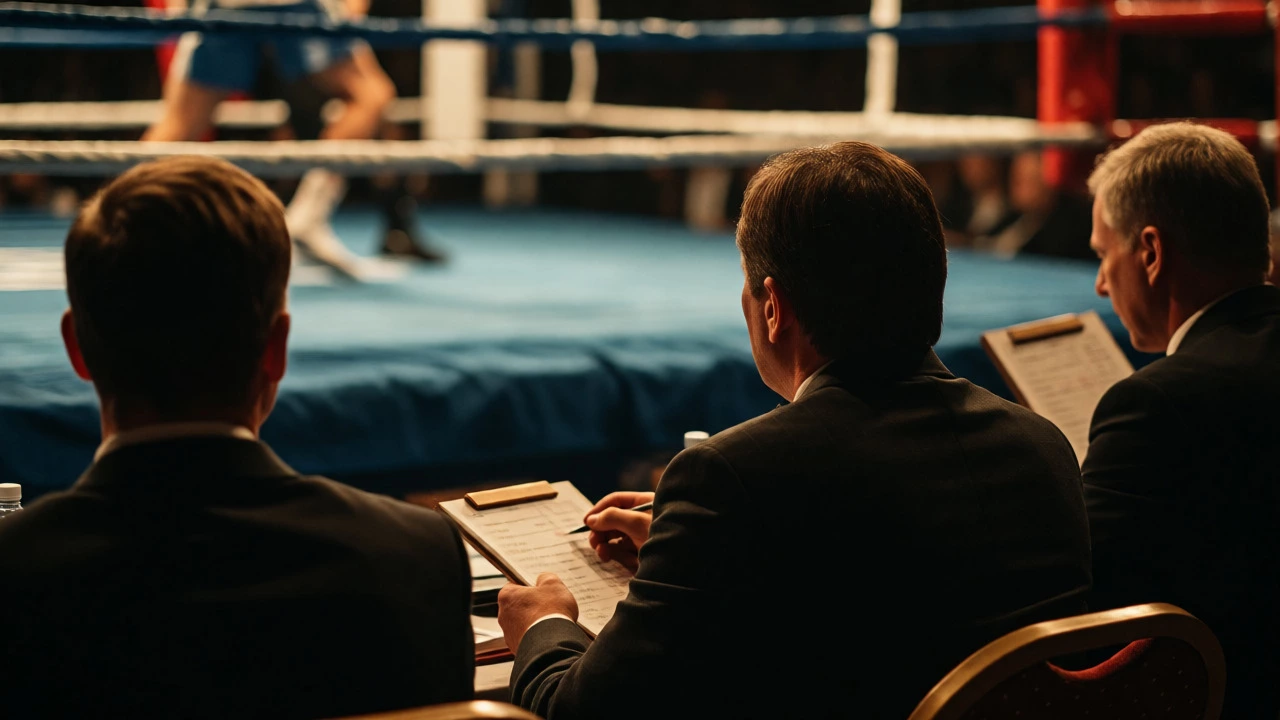
How to Judge Like a Pro: A Quick Checklist
Want to score the next big fight yourself? Grab a pen and paper. Here’s a practical way to apply the Rule of 3 during a live broadcast:
- Track Clean Hits: Don’t just count punches. Count the ones that visibly snap the head or body. Glancing blows don’t count much.
- Note Knockdowns: Mark down every time a fighter hits the canvas. Remember, each one costs a point on the scorecard.
- Watch Footwork: Is one fighter cutting off the ring? Is the other retreating in straight lines? Positional control favors the aggressor.
- Evaluate Damage: Did the opponent wince? Did they slow down? Visible fatigue or pain indicates effective aggression.
- Ignore the Crowd: Fans cheer for excitement, not necessarily scoring criteria. Stay objective.
By focusing on these tangible signs, you align your judgment closer to the official scorers. You’ll start seeing why a flashy dancer might lose to a plodding brawler who lands heavy shots. It’s not about style; it’s about substance.
The Evolution of Judging Criteria
It’s worth noting that these rules haven’t always been static. In the early days of boxing, scoring was even more ambiguous. Fighters could win simply by surviving longer or looking better. The introduction of standardized criteria helped legitimize the sport. Today, commissions like the Association of Boxing Commissions (ABC) train judges specifically on how to weight aggression versus defense. They emphasize that defense is secondary to offense. You can’t win by hiding forever; you have to engage.
Recent changes in some jurisdictions also aim to clarify "clean punching." With HD replays available to viewers, the disconnect between TV angles and ringside views causes frustration. Some advocates push for instant replay reviews for scoring, similar to tennis or football. While not yet standard, the conversation continues. For now, we rely on three humans in white shirts doing their best to apply the Rule of 3 in real-time.
Does landing more punches guarantee winning a round?
No. Quality matters more than quantity. Ten hard, clean punches that cause visible reaction are scored higher than fifty light taps that bounce off the guard. Effective aggression requires impact.
What happens if a round is perfectly even?
Under the 10-Point Must System, there are no draws in individual rounds. Judges must pick a winner. Even rounds are typically scored 10-9 in favor of the fighter who showed slight superiority in aggression or ring control.
Do judges see replays?
Generally, no. Professional boxing judges score the fight live from ringside without access to video replays. They rely solely on their visual perspective and memory of the round.
Can a fighter win with only defense?
It is very difficult. While good defense prevents damage, it does not demonstrate effective aggression. To win, a defensive fighter usually needs to land significant counter-punches to prove they are engaging effectively.
How do fouls affect the score?
If a referee issues a point deduction for a foul (like holding or low blows), that point is subtracted from the offending fighter's total score for the fight, not just the round. This can drastically change the outcome of a close bout.