How Long Is 12 Rounds of Boxing? Duration, Rules & Reality
Boxing Round Timer Simulator
Note on Realism: This simulator accounts for mandatory 1-minute rest periods between rounds. In real broadcasts, pre-fight ceremonies, knockdown counts, and commercial breaks extend the total viewing time significantly beyond the calculated ring time.
You’re watching a title fight. The bell rings for the twelfth round. Your legs are tense, your hands are sweating, and you’re wondering: how long is this actually going to take? Is it ten minutes? Twenty? An hour?
Here’s the straight answer: 12 rounds of boxing takes exactly 36 minutes of actual fighting time. But if you add in the rest periods between rounds, the total time from the first bell to the last is about 48 minutes. That’s just the clock. Add in pre-fight ceremonies, potential stoppages, and post-fight decisions, and a broadcast slot usually blocks out two hours.
The Math Behind the Clock
Let’s break down the arithmetic because it’s simpler than it looks. In professional boxing, specifically under the unified rules used by major commissions like the Nevada State Athletic Commission or the WBC, a standard round lasts three minutes. Between each round, fighters get one minute of rest. This isn’t optional; it’s mandatory for safety and strategy.
| Component | Duration | Total Accumulated |
|---|---|---|
| Round 1 | 3 minutes | 3 minutes |
| Rest Period 1 | 1 minute | 4 minutes |
| Rounds 2-12 (Fighting) | 33 minutes | 37 minutes |
| Rest Periods 2-11 | 10 minutes | 47 minutes |
| Round 12 (Final) | 3 minutes | 50 minutes |
Wait, did I say 48 minutes earlier? Close. Let’s do it precisely. You have 12 fights of 3 minutes = 36 minutes. You have 11 breaks of 1 minute = 11 minutes. 36 + 11 = 47 minutes. Why do people say 48? Because often there’s a brief pause before Round 1 starts while referees check gloves and mouthguards, or after Round 12 before the decision is read. So, budget for roughly 45 to 50 minutes of ring time.
Why Do We Even Have Rest Periods?
You might ask, why not just fight for 36 minutes straight? It would be shorter, right? Wrong. It would be dangerous. The one-minute rest period exists for a few critical reasons that go beyond just catching your breath.
- Corner Advice: Coaches use this minute to analyze what went wrong in the previous round. Did your opponent start dropping their left hand? Are they favoring their right leg? This tactical shift happens in real-time.
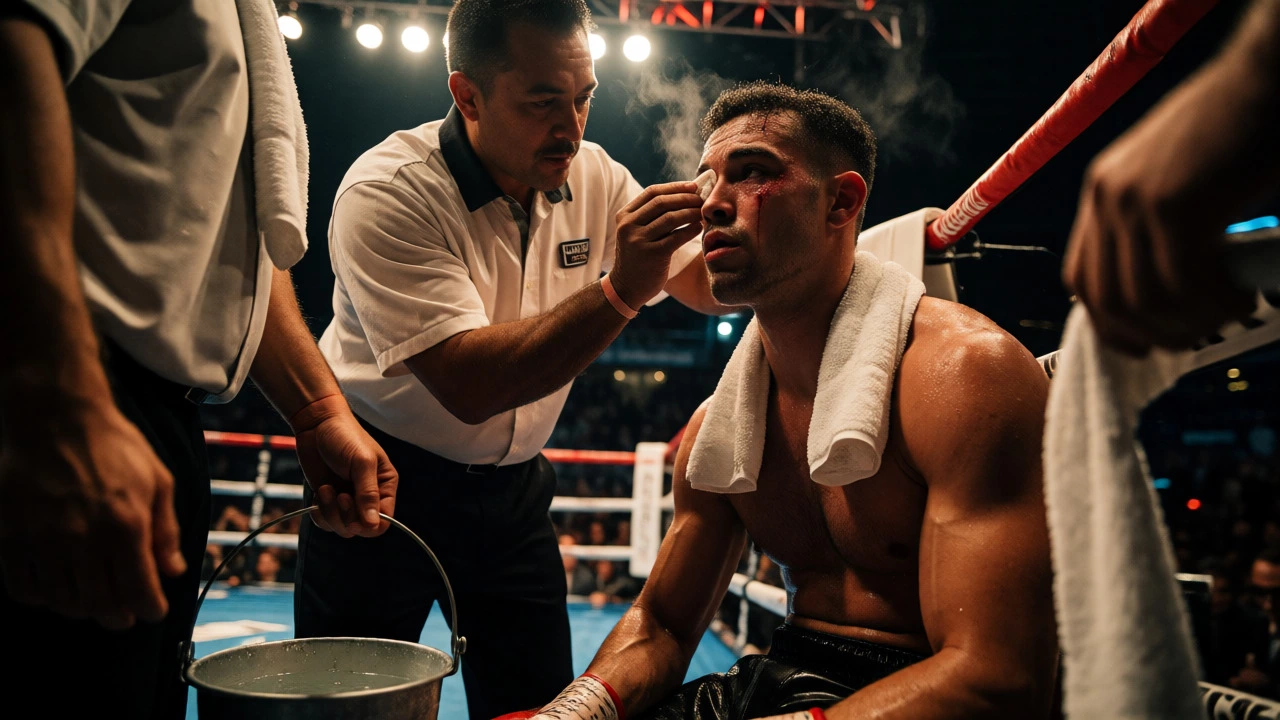
- Medical Checks: Cutmen work frantically to stop bleeding using adrenaline-soaked swabs and Vaseline. If a fighter has a severe cut, the doctor can step in during this minute to decide if the fight should continue.
- Hydration: Fighters sip water or electrolyte solutions. Dehydration leads to cramping, which ends careers.
Without these breaks, fatigue would accumulate so rapidly that technique would collapse within the first five minutes. You’d see sloppy, heavy-handed brawls rather than technical exchanges. The structure forces a rhythm: burst, recover, adapt, repeat.
Amateur vs. Professional: Not All Rounds Are Created Equal
If you’ve watched Olympic boxing, you might have noticed the pacing feels different. That’s because the rules differ significantly based on whether the contest is amateur or professional. Confusing the two is a common mistake for new fans.
In amateur boxing (now largely governed by the International Boxing Association or AIBA standards), bouts are typically shorter. For men, it’s usually three rounds of three minutes. For women, it’s also three rounds. The scoring system focuses heavily on clean hits registered by electronic sensors, so fighters move more and engage less in clinches. There’s no “knockout” focus in the same way; survival and point accumulation rule the day.
Professional boxing, however, scales up. Most non-title fights are scheduled for four, six, or eight rounds. A twelve-round fight is reserved for high-stakes matches-usually regional titles, national championships, or world title contenderships. The longer format tests endurance and mental fortitude far more than raw power alone.
The Real-Time Experience: What Actually Happens During Those 36 Minutes?
Knowing the math is one thing; experiencing the tension is another. When commentators talk about “rounds,” they aren’t just referring to time. They’re referring to strategic phases.
Early rounds (1-4) are often about feeling out the opponent. Fighters measure distance, test reactions, and conserve energy. You’ll see more movement and fewer heavy combinations. By the middle rounds (5-8), the pace accelerates. This is where the fight is often won or lost strategically. Fatigue sets in, but adrenaline masks it. Punches land harder because defense slips.
The late rounds (9-12) are pure survival and heart. Technique degrades. Fighters rely on muscle memory and conditioning. This is where champions separate themselves from contenders. Can you still throw sharp punches when your lungs burn and your arms feel like lead? If you can’t, you lose the decision, even if you landed more punches early on.
Factors That Stretch or Shorten the Time
The theoretical 47 minutes rarely plays out perfectly. Several variables can alter the timeline:
- Knockouts: If a fighter gets knocked down, the referee counts to ten. That adds 10 seconds per knockdown. Multiple knockdowns in a round can extend the active time slightly, though the clock stops during the count.
- Fouls and Stoppages: Low blows, headbutts, or slipping out of the ring cause pauses. The referee orders the offending fighter to a neutral corner. These interruptions can add minutes to the broadcast time without adding to the official “fight time.”
- Doctor Stoppages: If a cut becomes too severe, the ringside doctor may halt the fight mid-round. The bout ends instantly, regardless of how much time was left.
- TV Commercials: Broadcasters love drama. They will stretch the airtime with replays, interviews, and stats packages. While the fight itself is fixed, your viewing experience is flexible.

Why 12 Rounds Became the Standard
It wasn’t always 12. In the early 20th century, fights could last 15, 20, or even 50 rounds. The famous 1912 Jack Johnson vs. Jess Willard fight lasted 45 minutes of action across 45 rounds! It was brutal and often pointless.
The change to 12 rounds for title fights came gradually, solidified in the 1980s following tragic deaths in the ring. Promoters and commissions realized that 15-round marathons were causing unnecessary damage. Reducing the maximum length improved fighter safety without sacrificing the drama. Today, only a few jurisdictions allow 15-round fights, mostly in specific weight classes or legacy rules contexts, but 12 is the global norm for world titles.
Common Misconceptions About Fight Length
People often confuse “ring time” with “broadcast time.” If a TV network says a fight starts at 9 PM EST, don’t expect the main event to end at 9:47 PM. Undercard fights run first. There are weigh-ins, introductions, and pyrotechnics. The main event might not start until 10:30 PM. Plan accordingly if you’re watching live.
Another myth: “Longer fights mean better boxers.” Not necessarily. A knockout in Round 2 doesn’t mean the winner was inferior; it means they executed their game plan perfectly. Conversely, a fight that goes the distance isn’t automatically “better”; it might just mean both fighters had iron chins and poor finishing instincts.
What If You’re Training for a 12-Rounder?
If you’re an amateur trying to simulate a pro fight, you need to adjust your training. Three-minute rounds with one-minute rests are hard enough. Doing 12 of them requires serious aerobic capacity. Many gyms use “tabata-style” intervals or long-distance running to build the base. But nothing replaces sparring. You need to practice maintaining form when exhausted. Try shadowboxing for 3 minutes, rest for 1, and repeat 12 times. Notice how your hands drop by round 8. That’s the reality of the sport.
How long does a 12-round boxing match last in total?
A 12-round boxing match consists of 36 minutes of fighting time (12 rounds x 3 minutes) and 11 minutes of rest time (11 breaks x 1 minute). The total elapsed time from the first bell to the final bell is approximately 47 to 50 minutes, excluding pre-fight ceremonies and post-fight decision announcements.
Are all professional boxing fights 12 rounds?
No. Most professional bouts are scheduled for 4, 6, or 8 rounds. Twelve-round fights are typically reserved for championship bouts, major title eliminations, or high-profile matchups involving top-ranked contenders.
How long is a round in amateur boxing?
In most current amateur competitions, including the Olympics, rounds are typically 3 minutes long, but the number of rounds is lower (usually 3 rounds total). Some local amateur rules may vary, using 2-minute rounds, but the international standard aligns closer to professional timing for individual rounds.
Does the clock stop during a knockout count?
Yes. When a fighter is knocked down, the referee begins a count to ten. The round timer stops during this count. Once the fighter rises and the referee signals “OK,” the clock resumes. This ensures the fighter gets a fair chance to recover without losing valuable round time.
Why do some fights end before 12 rounds?
Fights can end early due to a knockout (KO), technical knockout (TKO), disqualification, or a draw declared by judges if scores are tied (though rare in modern scoring). Additionally, a doctor may stop the fight due to injury, such as a severe cut that cannot be controlled.