Why is it called boxing? The real origin of the name
Boxing Evolution Timeline
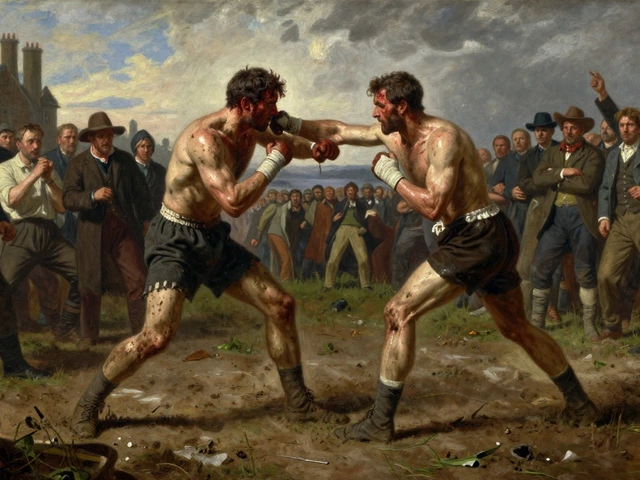
The word "to box" meant striking sharply with the fist. No gloves, no rings—just street duels.
Jack Broughton introduced 1-minute rounds and banned hitting a downed opponent. The first steps toward safety.
Rules formalized by the London Prize Ring Club. Rounds ended only when a fighter went down. Matches could last for hours.
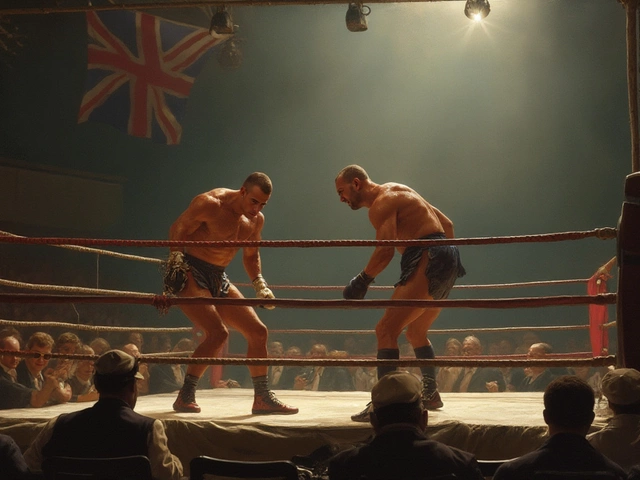
Padded gloves became mandatory. Introduction of 3-minute rounds, the square ring, and the 10-second count.
It sounds like a simple question. Why do we call it boxing when people are hitting each other with their fists? You’d think it would be called "fisting" or "punching." But language, especially in sports, rarely follows logic. It follows history, class struggle, and a lot of blood.
The short answer is that boxing comes from the word "box," which in the 17th century meant to strike someone sharply with the fist. But the long answer explains how a brutal street brawl evolved into a regulated Olympic sport, and why the name stuck even as the gloves got thicker and the rules got stricter.
The Etymology: From "Box" to "Boxing"
To understand the name, you have to look at the English language in the 1600s. Back then, the verb "to box" didn’t mean to put something in a cardboard container. It specifically referred to striking someone on the ear or face with an open hand or a closed fist.
Historical records show that by the mid-17th century, "boxing" was already being used to describe contests where men fought using only their hands. The Oxford English Dictionary traces this usage back to around 1681. So, unlike many sports that take their names from equipment (like golf or tennis), boxing takes its name directly from the action itself.
| Time Period | Meaning of "To Box" | Context |
|---|---|---|
| 1600s | To strike sharply with the fist | Street fights, duels |
| 1700s | Contested fighting with fists | Bare-knuckle prize fights |
| 1867+ | Regulated sport with gloves | Modern amateur/professional sport |
The Bare-Knuckle Era: When Boxing Was Dangerous
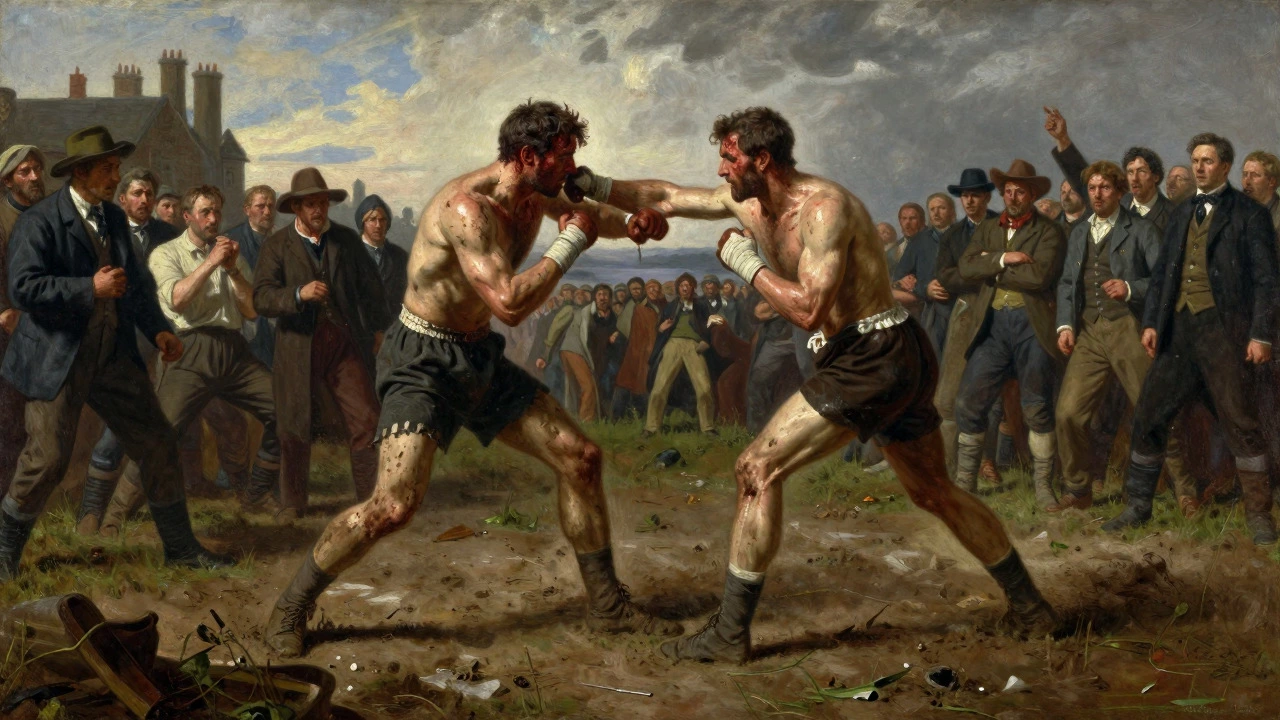
Before there were rings, ropes, or referees, there was just two guys standing in a field. This era, known as bare-knuckle boxing, dominated the 18th and early 19th centuries. These weren’t the clean, gloved matches you see on TV today. They were messy, bloody affairs that could last for hours.
In these early contests, fighters wore no gloves. Sometimes they wrapped their hands in leather strips or horsehair to protect their knuckles, but mostly it was skin against skin. The goal wasn’t just to knock someone out; it was to make them unable to continue. Since there were few rules, grappling, wrestling, and even kicking were sometimes allowed depending on the local customs.
Despite the chaos, the core mechanic remained the same: striking with the fists. Hence, it was still called boxing. The lack of protection made the sport incredibly dangerous. Broken noses, shattered jaws, and concussions were standard. Fighters often suffered long-term brain damage because the impact was direct and unmitigated.
The Jack Broughton Rules: First Steps Toward Regulation
If boxing had stayed completely wild, it might have been banned entirely. Enter Jack Broughton, a famous pugilist (that’s what boxers were called back then) who died in 1729 after a fight. His death highlighted the need for some basic safety measures.
In 1743, Broughton published a set of rules known as the Broughton Rules. These were the first attempt to codify the sport. Key changes included:
- Fighting in rounds of one minute, with rest periods in between.
- No hitting below the waist.
- No hitting a downed opponent.
- A fighter lost if he couldn’t get up within 30 seconds of falling.
These rules didn’t change the name, but they changed the perception. Boxing started to look less like a riot and more like a contest of skill. It began to attract spectators from higher social classes, not just the gambling crowds of the lower districts.
The London Prize Ring Rules
As the sport grew in popularity, the need for standardized rules became urgent. In 1838, the London Prize Ring Club formalized the existing customs into the London Prize Ring Rules. These rules governed bare-knuckle boxing for decades.
Under these rules, there were no time limits for rounds. A round ended only when one fighter went down. The loser had 30 seconds to "rise"-stand up without assistance. If he couldn’t, he lost. Matches could go on for dozens of rounds. The famous fight between Tom Sayers and John C. Heenan in 1853 lasted 40 rounds.
Even though it was regulated, it was still brutal. The term "boxing" persisted because the fundamental action hadn’t changed. Men were still boxing each other, just with slightly fewer dirty tricks allowed.
The Queensberry Rules: Birth of Modern Boxing
The biggest shift in the sport’s history came in 1867. The Marquess of Queensberry, a British aristocrat, collaborated with journalist John Graham Chambers to create a new set of rules. These became known as the Queensberry Rules.
This was the moment boxing transformed from a folk sport into a modern athletic discipline. The key innovations were:
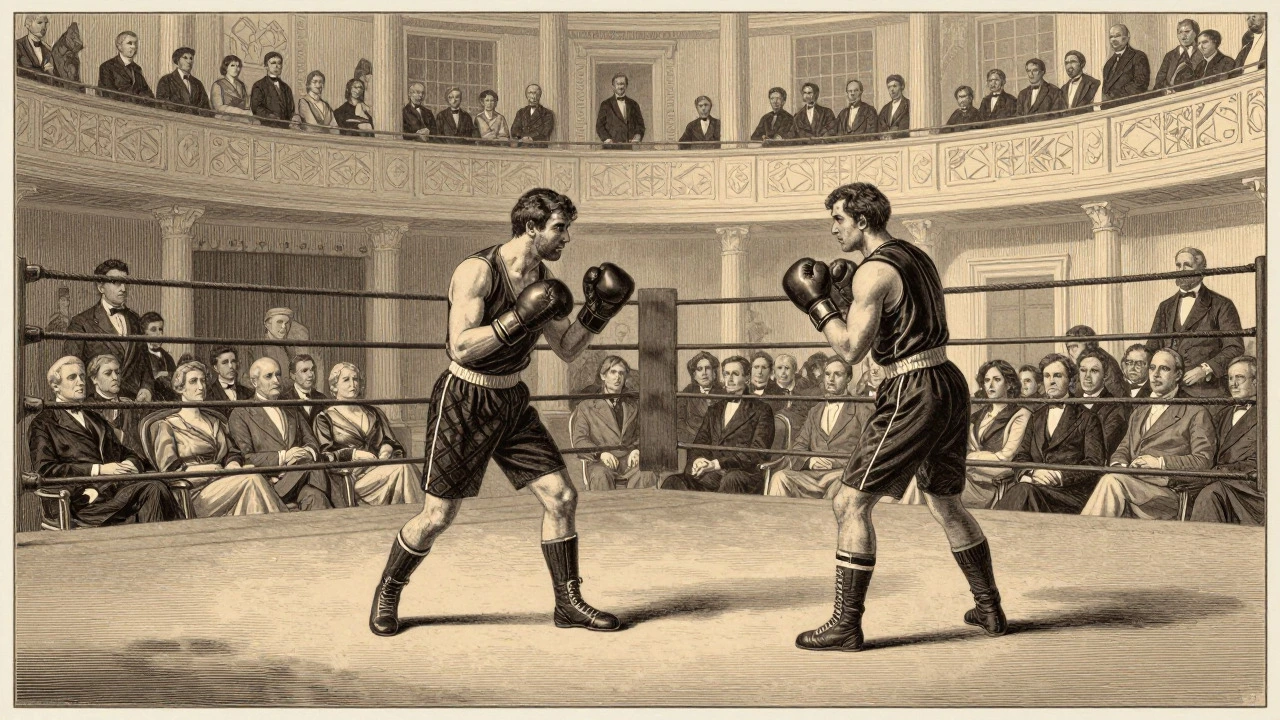
- Gloves: Fighters had to wear padded gloves. This reduced facial cuts and broken hands but increased the risk of brain trauma due to longer fights.
- Three-minute rounds: Fixed time intervals replaced the "down" system.
- The Ring: Fights took place in a roped square ring, preventing fighters from wandering off.
- Ten-second count: A referee counted to ten if a fighter was knocked down. Failure to rise resulted in a knockout loss.
The introduction of gloves is ironic. While they made the sport safer for the skin, they allowed fighters to punch harder and longer, potentially causing more cumulative brain damage. However, the visual change was significant. The sport now looked cleaner, more organized, and more respectable.
Why Didn't the Name Change?
You might wonder why the sport didn’t rebrand itself when it adopted gloves. After all, it wasn’t really "bare-knuckle" anymore. The answer lies in tradition and identity. By the late 19th century, "boxing" was deeply embedded in the cultural lexicon. Changing the name would have confused the public and alienated the existing fanbase.
Moreover, the essence of the sport remained unchanged. It was still about striking with the fists. The gloves were just equipment, like a bat in baseball or a racket in tennis. The action defined the name, not the gear.
There was also a class element. As boxing became more accepted by the upper classes, it shed some of its rougher associations. Keeping the name "boxing" helped maintain continuity with its past while signaling a new, refined era. It was a way of saying, "We’re keeping the spirit, but improving the presentation."
Global Variations and Related Terms
While "boxing" is the standard term in English-speaking countries, other languages have different words that reflect similar historical developments. For example, in Spanish, it’s "boxeo," derived from the English loanword. In French, it’s "boxe." This shows the global influence of British sporting culture during the 19th and 20th centuries.
Interestingly, some related combat sports have distinct names despite similar mechanics. Muay Thai, for instance, allows elbows and knees, so it’s not considered boxing. Kickboxing adds kicks. But pure fist-fighting, whether with or without gloves, generally falls under the umbrella of boxing.
Did boxing always use gloves?
No. For most of its history, boxing was fought bare-knuckled. Gloves were introduced in the 1867 Queensberry Rules to reduce injury and make the sport more socially acceptable. Before that, fighters sometimes used leather wraps, but heavy padded gloves were rare.
Who invented boxing?
No single person invented boxing. Fist-fighting has existed since ancient times, including in Greece and Rome. However, modern boxing as a regulated sport developed in England in the 18th and 19th centuries through figures like Jack Broughton and the Marquess of Queensberry.
What is the difference between bare-knuckle boxing and modern boxing?
The main differences are the use of gloves, round structure, and rules. Bare-knuckle boxing had no time limits, allowed grappling, and ended when a fighter couldn’t rise. Modern boxing uses three-minute rounds, requires gloves, and has a strict rulebook enforced by a referee.
Why is it called a "ring"?
Originally, spectators formed a literal circle or "ring" around the fighters. Later, ropes were added to define the space, but the name stuck. The square shape became standard in the 19th century for better visibility and safety.
Is boxing an Olympic sport?
Yes. Amateur boxing has been part of the Summer Olympics since 1904, except for 1912. Professional boxing is not part of the Olympics, but many pros start their careers in the amateur ranks.
Conclusion: The Name Stays, The Sport Evolves
So, why is it called boxing? Because for hundreds of years, it was exactly that: a contest of boxing blows. The name survived the transition from bare knuckles to padded gloves because the core action never changed. It’s a reminder that sports are living things, shaped by culture, safety concerns, and human ingenuity. Whether you’re watching a gritty underground match or a glitzy championship bout, you’re witnessing the same fundamental activity that started in the streets of London centuries ago.